


“ Discover why arguments escalate and how the conflict cycle affects relationships. Learn common patterns, emotional triggers, and practical tools to break the cycle and reconnect with your partner. ”
Most couples don’t argue about what they think they’re arguing about; they’re arguing about something underneath it. Every couple has a conflict cycle, especially during moments of tension. You and your partner naturally bring individual personalities, communication styles, and personal histories into the relationship. These dynamics shape the patterns you both fall into, and when emotions rise, many couples find themselves repeating the same conflict cycle.
Without awareness, arguments can escalate quickly, leaving both partners feeling confused, hurt, or shut down. The encouraging part is that once you recognize and understand your conflict cycle, you can interrupt it long before things spiral.
This article will help you recognize what’s happening beneath the surface and guide you through practical tools to reconnect—without pressure to be perfect or have everything figured out. Try these steps slowly and compassionately, noticing which ones help you feel more grounded and connected.
Why Conflict Cycles Happen
Our nervous systems are designed for protection. Strong emotions can trigger a “not safe” alert in the body—even when the situation itself isn’t truly threatening. This isn’t a personal or moral failure; it’s biology. This response shows up differently for everyone and is a normal part of even healthy relationships.
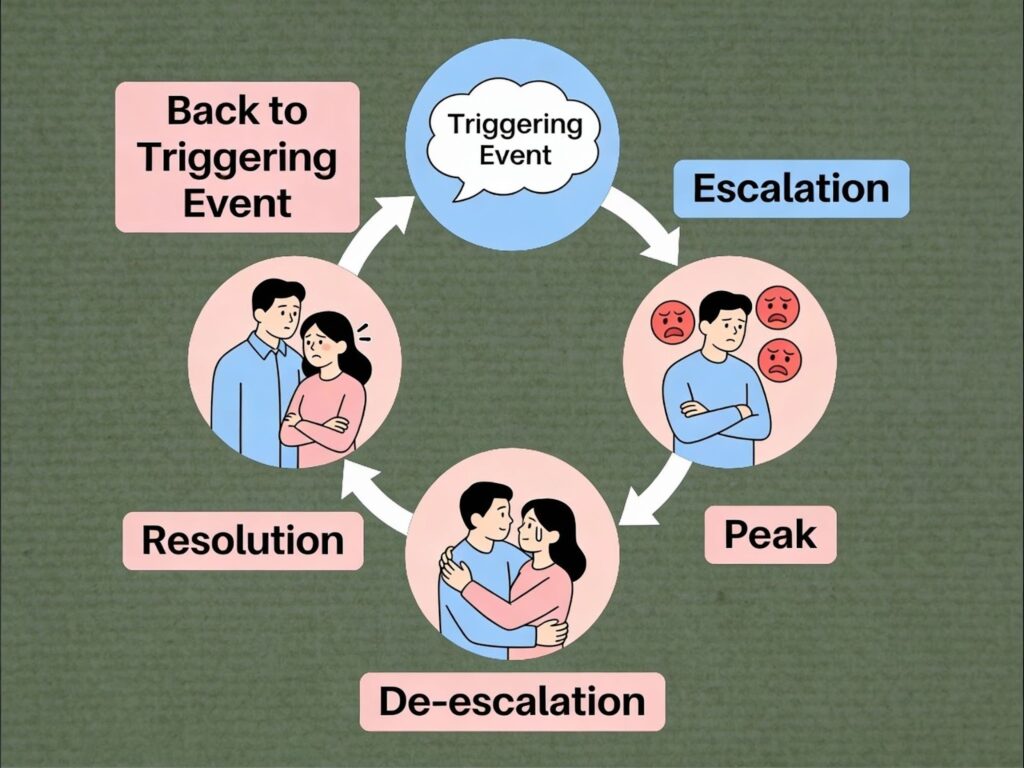
Common Triggers That Activate a Conflict Cycle
- Feeling unheard or dismissed
- Sensing emotional distance or withdrawal
- Interpreting tone or expressions as criticism
- Unresolved stress
- Past negative experiences being re-triggered (even if they didn’t happen with your partner)
In the moment, you and your partner aren’t actually fighting about laundry or dishes. You’re reacting to what that moment represents emotionally. Internal feelings often show up as reactions that don’t fully express what you’re really needing.
Beneath most conflict cycles are quieter questions such as:
- Do you still care about me?
- Am I important to you?
- Are we okay?
Reflecting on these questions can reveal the deeper needs driving your reactions during conflict.
Common Conflict Cycle Patterns in Relationships
Most couples slip into one or more predictable conflict cycle patterns. Notice which dynamics feel familiar in your relationship.
The Pursue–Withdrawal Cycle
One partner moves toward the conflict (“Let’s talk right now”), while the other moves away (“I need space”).
- The more the pursuer pursues, the more the withdrawer withdraws
- The more the withdrawer withdraws, the more the pursuer pursues
Both partners feel flooded and emotionally alone.
The Shutdown–Explode Cycle
One partner shuts down to stay calm, while the other becomes increasingly expressive.
- The quieter one gets, the louder the other becomes
- The louder one becomes, the quieter the other gets
Both partners feel misunderstood.
The Tit-for-Tat Cycle
Small frustrations stack up until both partners exchange subtle jabs. This cycle often shows as sarcasm or sharpness but is driven by underlying emotional overwhelm.
The “We’re Not Okay” Cycle
A minor disagreement quickly turns into fear about the relationship itself.
- “This conversation isn’t going well” becomes
- “Are we drifting apart?”
Becoming aware of your conflict cycle is the first step to interrupting it.

What’s Really Happening Underneath Your Conflict Cycle
Every conflict cycle is driven by one or both of the following:
Unmet Emotional Needs
Examples include:
- Reassurance
- Closeness
- Respect
- Predictability
- Feeling valued
When these needs feel neglected, tensions rise.
Nervous System Survival Response
Your body may shift into:
- Fight (pursuing, raising your voice, protesting)
- Flight (withdrawing, avoiding, walking away)
- Freeze (shutting down, going blank)
- Fawn (people-pleasing to avoid conflict)
Recognizing these responses allows you to meet your partner with empathy instead of defensiveness.
How to Interpret Your Conflict Cycle in Real Time
Here’s a simple, actionable framework you can use immediately:
Step 1: Notice the Shift Early
Pay attention to early physical cues: shallow breathing, chest tightness, heat rising, or urges to shut down or “fix things now.” Naming what’s happening—“I think I’m getting worked up”—can slow the conflict cycle immediately.
Step 2: Take a Regulating Pause
Pausing is healthy when communicated clearly. Example script:
“I’m noticing I’m getting overwhelmed. I care about this, and I want to talk about it. I just need a short break so I can come back calm. I will check in with you in 10 minutes.”
This shows your partner that you’re not leaving the conversation, helping interrupt the cycle safely.
Step 3: Regulate Your Body, Not the Problem
Calming your nervous system can reduce the intensity of the conflict cycle:
- Place your feet flat on the ground
- Exhale longer than you inhale
- Relax your jaw and shoulders
- Run cold water over your hands or face
- Place an ice pack on your chest or neck
When the body settles, the mind follows.
Step 4: Return for Reconnection
Use this structure after the pause:
- Name your intention
- “I want us to feel connected again.”
- Acknowledge your emotions
- “I was feeling overwhelmed and worried I wasn’t being understood.”
- Validate their experience (even if you don’t fully agree)
- “I can see this was really important to you.”
- Share what you need moving forward
- “Can we slow the pacing down so I don’t feel the need to shut down?”
This builds repair instead of more distance or resentment.
Step 5: Use a 60-Second Micro-Check-In
Each partner answers:
- “Right now I feel…” (tired, flooded, anxious, hopeful, overwhelmed, disconnected, confused, guarded)
- “Right now I need…” (reassurance, space, clarity, patience, a slower pace, a pause)
This keeps communication grounded and prevents the conflict cycle from escalating again.

How You and Your Partner Can Practice Breaking the Conflict Cycle
No cycle is broken overnight. but practicing small micro-skills makes a huge difference. The goal isn’t to completely eliminate conflict but to make it feel safer and more secure.
Try:
- Pausing at the first noticed sign of dysregulation
- Naming your internal experience instead of focusing on your partner’s behavior
- Slowing down instead of speeding up
- Checking in with each other before things escalate
- Repairing as soon as distance is felt
References/Influences:
Emotionally Focused Therapy (EFT)
Gottman Method Couples Therapy
PACT (Psychobiological Approach to Couple Therapy)
Polyvagal Theory (as a framework for understanding nervous system states)